
5 Mistakes to Avoid With Driveway & Pavers
Four of the five most expensive paver mistakes we see in Glendale are invisible on the day the crew drives away. They show up six months later, when the rains come or the ground shifts, and by then the contractor who cut the corner is unreachable. The good news: none of these mistakes happen by accident. Each one traces back to a conversation that never got had, or a detail that never got written down, before work started. Here are the five, in the order they tend to bite.
1. Skipping Real Compaction on the Base
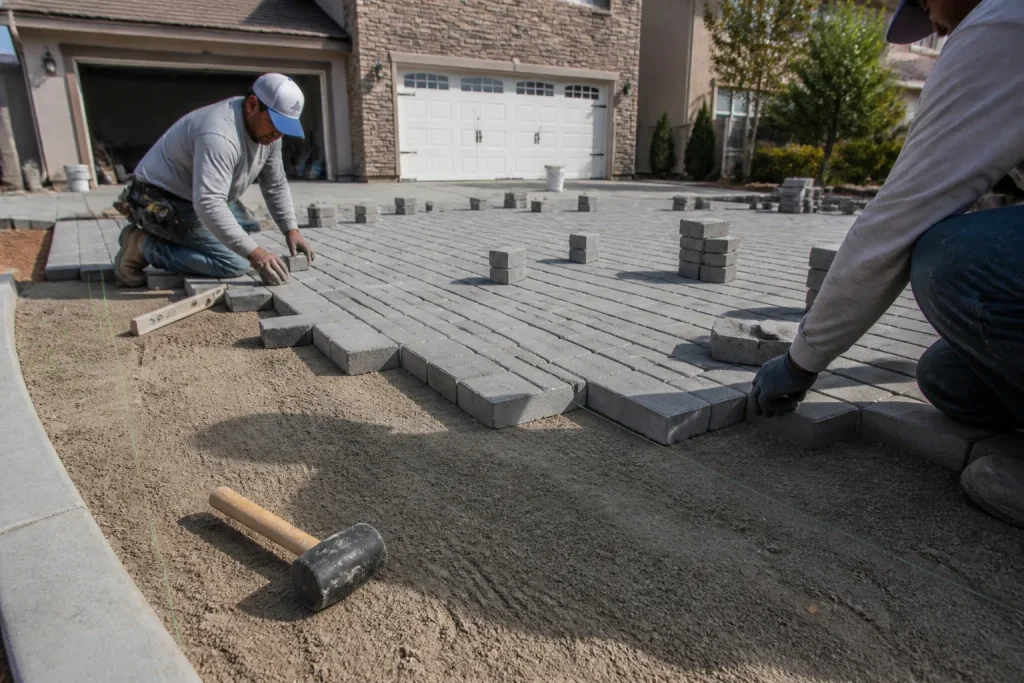
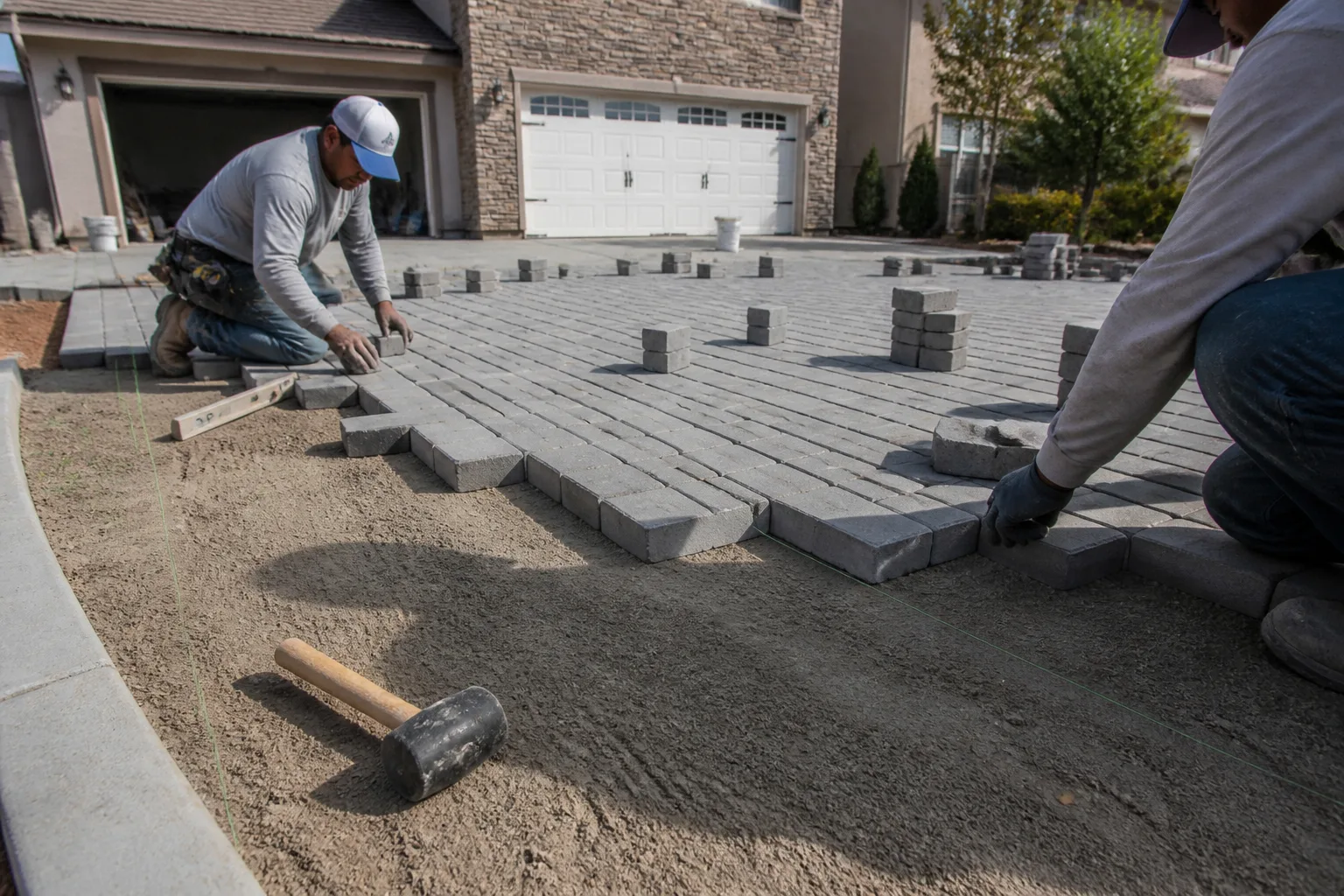
The single most common failure we find in Glendale driveways is a base that looks flat and feels solid but was never properly compacted in lifts. A paver surface is only as good as what’s under it. If the contractor excavated, tossed in a foot of base rock, and ran a plate compactor over the top once, the material underneath is still loose. It looks perfect for a season. Then it settles unevenly, and every imperfection telegraphs straight up through the pavers – ripples, rocking stones, sunken joints.
Here’s why Glendale punishes this specifically. We get long dry stretches, then concentrated winter rain, and a lot of driveways sit on clay-heavy soil that expands when it wets and shrinks when it dries. A base compacted correctly – in 2 to 4 inch lifts with vibration, moisture-checked, and run at 90% or better density – gives that soil movement somewhere to go. A base that wasn’t gives you fault lines within one or two wet seasons. We pulled a driveway apart over in Adams Hill last spring where the pavers were barely two years old. The compaction was the whole story.
What to ask before you sign
- How deep is the base going, and how many compaction passes per lift?
- Will you check compaction with a plate test or density meter, and can I see the numbers?
- What’s the soil like here, and does the base depth change for clay?
If the answer is a shrug and “we’ve done hundreds of these,” that’s not an answer. The compaction step is invisible in the finished product, which is exactly why corner-cutters skip it – you won’t know until it’s too late.
2. Choosing the Wrong Joint Sand
Paver joints fail for one of two reasons: the wrong sand went in, or the right sand went in wrong. In Glendale, both happen constantly. The choice is between polymeric sand, which hardens and locks pavers together, and regular washed sand, which stays loose. Each has a place, and picking wrong is a mistake that shows up fast in our climate.
Polymeric sand is the right call for most residential driveways in Glendale – if it’s installed correctly. It has to go into dry joints, get compacted in, and cure without rain for the manufacturer’s window. Get lazy with it and it hazes the paver faces or washes out at the edges. Regular sand is cheaper and more forgiving on drainage-heavy layouts, but in a Glendale driveway it tends to migrate. Between the temperature swings we get in the foothills, sprinkler overspray, and the occasional atmospheric river, loose sand ends up on the sidewalk within two winters.
There’s also a chemical side to this. Sealing over polymeric sand too soon traps moisture and clouds the surface. Some crews try to save a trip and seal the same week. Don’t let them. We don’t seal until the manufacturer’s cure window is up and we’ve checked for rain in the forecast. If you’re curious about the broader material side of the project, our Driveway & Pavers in Glendale page walks through the options we install, including Belgard and Techo-Bloc lines.
Quick joint sand cheat sheet
- Polymeric: best for most Glendale driveways, needs dry install and a clean cure window.
- Regular washed sand: cheaper, better on steep or high-drainage layouts, but needs periodic topping up.
- Never mix them and never apply one over the other without a full joint clean-out.
3. Ignoring Glendale’s Driveway Approach Permit
This one is quiet until it isn’t. Your driveway meets the street with an apron – the ramp section between the sidewalk and the curb. In Glendale, that apron and the curb cut are not yours to rebuild however you like. They live in the public right-of-way, and work there generally requires a permit from the city, often tied to a curb-cut or driveway approach spec and sometimes an inspection before and after.
The catch is that a lot of contractors skip it. We’ve heard the line more than once: “You don’t need a permit, it’s just pavers.” That’s true for the portion behind the property line. It is not true for the approach at the street. When the work is unpermitted and the day comes to sell the house, that work surfaces in the buyer’s inspection and in title searches, and you’re the one explaining it to a city inspector – not the paver company that’s long gone.
Permits also protect the job itself. The city has requirements for slope, drainage, and how the approach meets the curb that prevent water from pooling against your garage or running off onto the sidewalk and freezing nose-down at the neighbors.
When to pull the permit
- Any time the curb cut or apron is being replaced, widened, or repoured.
- When the driveway widens beyond the existing approach – even slightly.
- When you’re adding a new driveway, gate, or turnaround.
Note that a lot of contractors won’t mention this at all because the permit office is a hassle. We pull them because the inspector’s job is to protect the homeowner, not the builder. If you’re thinking about a driveway and a new property line at the same time, take a look at our Fence Installation in Glendale page – permits and property surveys often overlap on those two projects.
4. Ordering Materials Before the Base Is Exposed
Here’s a mistake that costs more than it looks. Lots of contractors will lock in the paver order – full quantity, one color lot, delivery scheduled – before they’ve dug down to see what the base actually looks like. That’s backwards. You can’t know how much base material you’ll need, how deep the excavation goes, or how much overage for cuts until you’ve opened the ground and seen if there’s old concrete, a buried footing, or more clay than the soil test suggested.
Two things go wrong. First, quantity errors. The crew comes up short on pavers mid-install, orders a second batch, and now you have a visible color-lot mismatch where the two pallets meet. Glendale is sunny enough that this shows within a month. Second, the schedule dies. The base turns out bigger than expected, the pavers sit on the curb for three weeks in the rain, and now you’re paying for restock or dealing with stained product. We don’t order a single paver until base prep has exposed the site and we know what we’re actually building on.
This is also why written allowances matter so much on hardscape jobs. If the quote has a line for “base material” that was guessed before excavation, you should know that number can move. On our jobs, that number is either fixed with the scope in writing or we come to you with a written change order before we proceed – not a surprise invoice at the end.
5. No Written Change-Order Process
The most common story we hear from Glendale homeowners goes like this: “While you’re out there, could you add a border?” Then, three weeks later, an invoice with three additions the homeowner doesn’t recognize and can’t disprove. Verbal additions have a way of becoming disputed invoices. The fix isn’t to avoid changes – good projects always change a little once the ground is open – it’s to have a written process that captures each change before the work happens.
Every scope, every allowance, every price change arrives in writing before work proceeds on our jobs. We sit with you, we note the addition and the number, and you sign it before a single paver gets cut. If it’s not on paper, it doesn’t happen. That one rule eliminates nearly every drive-by-night horror story we hear about. It’s the same reason we publish Tom Barrett’s name and license number – if something’s off, you should know exactly who to call.
What a clean change order includes
- 1
A plain description of what’s being added or removed.
- 2
The exact dollar figure – not a range, not “TBD.”
- 3
How it affects the schedule, if at all.
- 4
Your signature and a copy for your records.
One light note from the field: the phrase “while we’re at it” has probably cost homeowners more in our county than any single other three words. Not because they shouldn’t ask – they should. Because the answer should live on paper, not in a text thread.
When to Call a Pro
If your driveway has any rocking pavers, sunken joints, weeds pushing up through the surface, or a section that pools water after rain, those are all signs of base or joint problems. They’re also the kind of work that gets worse, not better. A proper fix means pulling pavers, correcting the base, and reinstalling with the right joint sand – which is a job for a crew with a plate compactor and a permit book, not a weekend of YouTube.
We also want to say this plainly: some of the work in this piece is genuinely dangerous to get wrong. Undermining a curb cut or digging near a gas line in the public right-of-way can cause real injury and real fines. Let a trained, permitted crew dig. We carry the brands you can look up – Belgard and Techo-Bloc on hardscapes, GAF and CertainTeed on roofs, KraftMaid and Cambria in kitchens – because we’d rather install something a homeowner can verify than mystery materials off a van.
Related services in Glendale: Driveway & Pavers, Fence Installation, and Home Additions & ADU. If you’re planning a bigger project and want the lay of the land, our Barrett & Sons Construction Glendale home page is the front door.
The Bottom Line
None of these five mistakes are exotic. They’re the everyday shortcuts we see on driveways across Glendale, and each one comes back around on the homeowner a season or two later. The fix isn’t complicated either – it’s just a conversation. Ask about compaction depth and soil. Ask which joint sand goes in and how it cures. Ask who pulls the driveway approach permit. Ask how materials are ordered and when. And ask for the change order process in writing before the first load of base rock shows up. If a contractor balks at any of those questions, that’s your answer.
If you’re in Glendale and want a straight answer on a driveway project, Barrett & Sons Construction Glendale offers free estimates, written line-item scopes, and permits pulled and inspected on every eligible job. Our technicians have up to 28 years of experience, and every completed job comes with the written 90-Day Done Right Promise – one call and we come back. Call (844) 560-4526 to schedule your free estimate, or ask about our current standing offers: $40 off any repair over $200, a free second opinion on any written estimate, and no trip charge inside the county, plus a permanent 10% senior and veteran discount. Calls are answered by a live person, 24/7.
Frequently Asked Questions
Repair costs in Glendale typically run a fraction of a full replacement if the base is sound – often in the range of reseating and re-sanding the affected section rather than rebuilding the whole driveway. If the base itself failed, the fix requires pulling pavers, correcting compaction, and reinstalling, which lands much closer to a replacement number. Call (844) 560-4526 for an exact quote – estimates are free and we’ll tell you honestly which kind of fix you’re looking at.
Polymeric sand is the right choice for most Glendale residential driveways because it locks pavers together and holds up to the area’s dry summers and winter rain better than loose washed sand. The key is proper installation – dry joints, correct compaction, and a clean cure window with no rain. Call (844) 560-4526 if you’d like us to look at an existing driveway and tell you what’s in it.
For the portion of the driveway behind the property line, generally no. For the apron and curb cut at the public street, yes – that work lives in the right-of-way and usually requires a permit and inspection from the city. Unpermitted apron work is a common problem that surfaces at resale. Call (844) 560-4526 and we’ll walk you through whether your project needs one.
Most residential paver driveways in Glendale take several days to a week or more from base prep through joint sand and cleanup, depending on square footage, soil, and whether the driveway approach is being rebuilt. The base is the part that cannot be rushed – cut days there and you pay for it later. Call (844) 560-4526 for a written scope that spells out the schedule before work starts.
Written by the team at Barrett & Sons Construction Glendale.
Need Construction Help?
Call Barrett & Sons Construction Glendale - licensed & insured, here with fast after-hours help in Glendale.
(844) 560-4526