
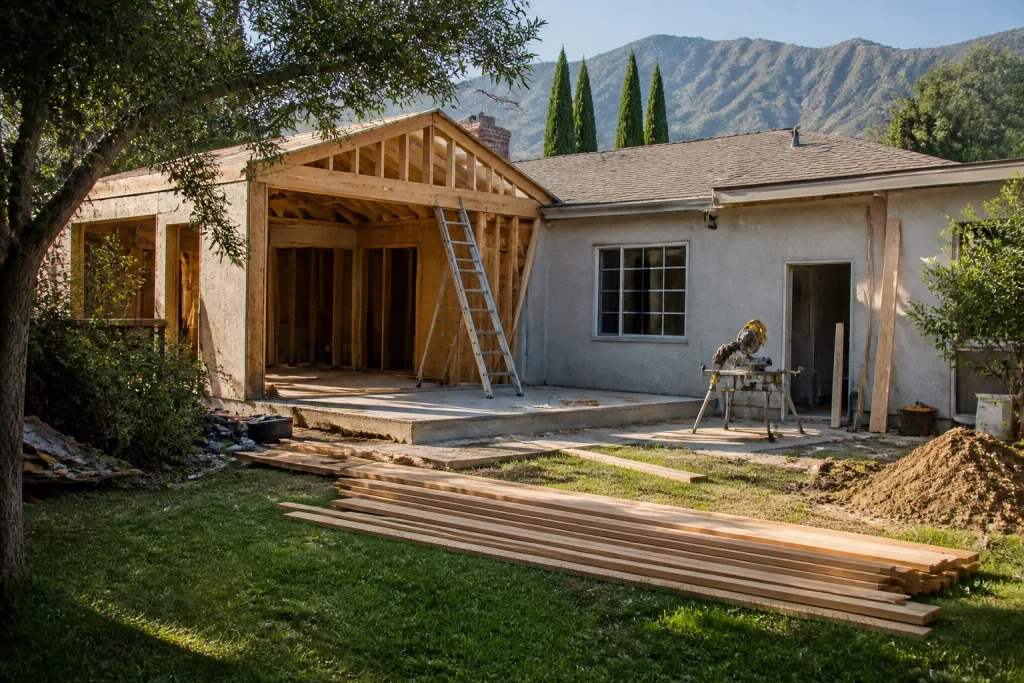
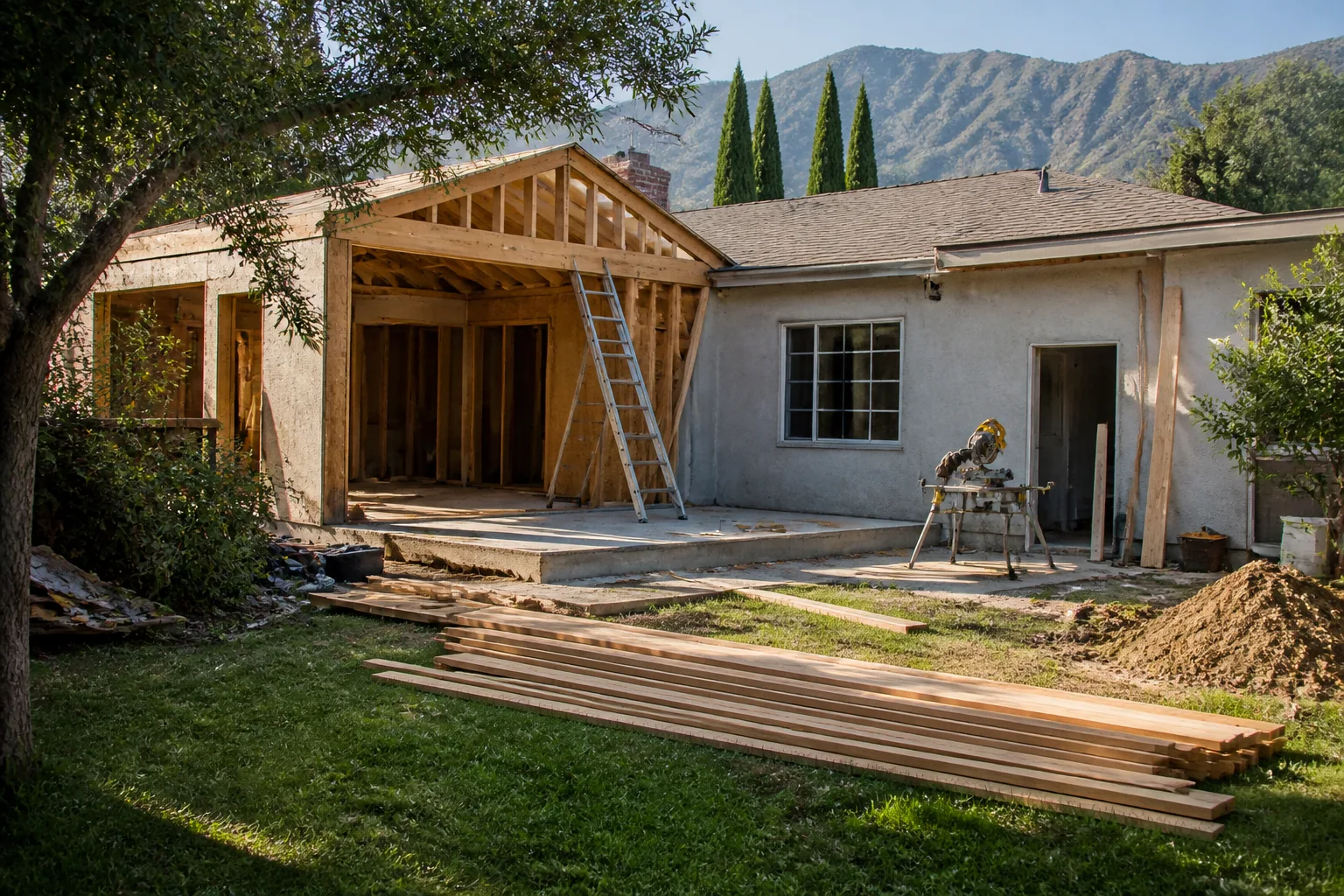
5 Mistakes to Avoid With Home Additions & ADU
The five costliest home addition and ADU mistakes in Glendale all happen before anyone picks up a hammer: designing before confirming the lot’s setback and coverage numbers, assuming the existing panel and sewer can handle the load, bundling permits into a lump-sum design-build price, picking a configuration off cost per square foot alone, and running scope changes without a signed change order. Get those first 60 days right and you avoid most of the overruns that make these projects infamous. If you’d rather not go it alone, call (844) 560-4526 and we’ll walk the lot with you before you spend a dime on drawings.
We’ve re-bid more than a few Glendale ADU projects where the homeowner had already spent $15,000 on plans that couldn’t be permitted. Not because the architect did bad work. Because nobody confirmed the parcel’s setback and lot-coverage numbers before the design started. That’s a painful check to write twice, and it’s completely avoidable.
1. Designing Before You Confirm the Numbers for Your Specific Glendale Parcel
This is the mistake that sinks more Glendale ADU projects than anything else, and it happens in the first week. Glendale’s ADU standards have shifted a lot in recent years, and the state rules that override local ones don’t apply the same way to every lot. Before a single line is drawn, you need to know the answers to four questions about your specific parcel:
- Lot coverage and floor area ratio. How much of your lot can be covered, and how much floor area you’re allowed to add. This number differs block to block in Glendale depending on zoning and whether you’re in a hillside or flatland area.
- Setbacks. Front, side, and rear. The rear setback for an ADU is often the tightest constraint on a typical Glendale lot, and it changes with the configuration you pick.
- Utility connections. Where the sewer lateral, water line, and electrical service actually run, and whether they can reach the new structure without a major upgrade. On older Glendale parcels, this is where budgets quietly blow up.
- Fire access. Whether a fire engine can physically reach the back of the lot, which on hillside streets and narrow lots in Glendale is a real question, not a formality.
None of this is the architect’s job to guess. Pull your parcel’s zoning and coverage information first, then hand those numbers to the designer. It’s the difference between a set of plans that sails through plan check and a set that sits in the reject pile while you pay storage on a dumpster.
2. Assuming the Main House Can Carry the Addition
We’ve walked plenty of Glendale properties where the homeowner assumed the electrical panel, foundation, and sewer lateral were ready for more load. They usually aren’t. A home addition or ADU adds demand to systems that were sized for the house as it stood, sometimes decades ago. Three assessments need to happen before you commit to a design:
- The electrical panel. Does the existing service have the capacity for a second dwelling, or does it need an upgrade? Panel upgrades add real cost and real time, and they need to be on the plan from day one, not discovered at rough-in.
- The foundation and existing structure. If the addition ties into the main house, the connection point matters. Older foundations in Glendale don’t always take a new load cleanly, and a structural engineer needs to weigh in before the design is locked.
- The sewer lateral. This is the quiet one. A lateral that’s undersized or in poor condition may need replacement to serve an ADU, and that’s excavation work that runs under your driveway or yard. Better to know now.
Get all three assessed before you sign a design contract. A few hundred dollars of assessment up front saves a five-figure surprise later. This is also where a contractor’s eyes help: someone who’s opened up systems on Glendale homes can tell you what to expect.
3. Signing a Design-Build Contract That Buries Permits in the Lump Sum
When permit costs and timelines get folded into one big design-build number, you’ve lost visibility into a piece of the job that has real money and real schedule attached to it. Ask for permits as a separate line item, every time. Here’s why it matters in Glendale specifically:
- Permit fees are knowable. They’re based on valuation and scope, and they should show up as their own line on the quote, not disappear into a round number.
- Plan-check timelines are real. Glendale’s plan-check queue has stretches where it moves fast and stretches where it doesn’t. A contractor who lists permits separately can tell you the actual timeline they’re planning around, instead of a date pulled from thin air.
- Inspections belong to you. The permit inspector works for you, not for us. That’s the whole point. An inspector signs off on framing, electrical, and plumbing before walls close up, and a contractor who tries to skip that step is cutting the one safety check you actually get for free.
We pull permits and get inspections signed on every eligible job, and we list permit costs separately so you can see exactly what’s what. If a bid won’t show you the permit line, ask why. The answer usually tells you everything.
4. Picking an ADU Configuration on Cost Per Square Foot Alone
Cost per square foot is a fine starting number. It’s a terrible decision-maker. A detached ADU, an attached ADU, and a garage conversion all have very different economics once you factor in what the finished unit does for your property in your specific Glendale neighborhood. The mistake is stopping at the square-foot price instead of modeling the two numbers that actually pay you back:
- Rental income. What a comparable ADU in your area actually rents for. A detached unit in one Glendale neighborhood and a garage conversion a few streets over can rent for meaningfully different amounts, and the gap changes the payback math.
- Resale comp impact. How an ADU affects value on your street. In some Glendale pockets, a permitted ADU is a strong value-add at sale. In others, buyers care more about the main house and yard, and the ADU moves the needle less than the spreadsheets promise.
Model both before you choose a configuration. A garage conversion is often the fastest and least expensive path, but it gives up rent and flexibility compared to a detached unit. A detached build costs more up front but may earn more each month. Neither is automatically right. The right one depends on your lot, your budget, and what your Glendale street actually supports.
5. Running Scope Changes Without a Signed Change Order
Every project changes. A window gets moved, a wall gets added, a finish gets upgraded. The mistake isn’t making changes. It’s making them without a written, signed change order before work moves forward. This is where budgets and relationships both go sideways.
Here’s the rule we work by: scope in writing, allowances in writing, change orders in writing. An allowance that isn’t on paper is a surprise waiting for a date. When a change order covers every scope shift, every allowance, and every price adjustment, and it’s signed before the next nail moves, you never get the end-of-job invoice that doesn’t match the conversation you remember. The change order is the paper trail that protects both sides.
So when your contractor says “don’t worry, we’ll sort it out at the end,” that’s your cue to worry. Ask for the change order. A contractor confident in their numbers will hand it to you without blinking.
When to Call a Pro
Some of this you can check yourself: pull your parcel’s zoning info, read your panel label, find the cleanout on your sewer line. The moment the assessment turns into real structural, electrical, or civil questions, that’s when you want a licensed contractor walking the lot with you before the design gets locked. Those are the systems where mistakes get expensive and where a trained set of eyes saves you real money.
Related services in Glendale: when the addition is done, the driveway that got torn up for a sewer line and the fence around a new ADU both matter. Our Driveway & Pavers in Glendale team can restore a torn-up driveway with Belgard or Techo-Bloc, and our Fence Installation in Glendale crew can handle security fencing in Ameristar or Jerith steel once the ADU is standing. Start with our Home Additions & ADU in Glendale page for the full picture, and see everything we do back at the Barrett & Sons Construction Glendale home.
The Bottom Line
Nearly every expensive ADU or home addition disaster in Glendale traces back to the planning phase, not the build phase. Confirm your parcel’s setback and coverage numbers before design. Assess the panel, foundation, and sewer lateral before you commit. Insist on permits as a separate line item. Model rental income and resale impact, not just cost per square foot. And require a signed change order for every scope shift. Do those five things and you’ll sidestep most of what makes these projects go wrong.
If you’re in Glendale and need help with a home addition or ADU, Barrett & Sons Construction Glendale offers free estimates. No-hassle upfront pricing, written change orders before any scope change, permits pulled and inspections signed, and every completed job backed by our written 90-Day Done Right Promise. Call (844) 560-4526 and a live person will pick up. We also offer a free second opinion on any written estimate you’re holding, and a permanent 10% Senior & Veteran discount.
Frequently Asked Questions
Most Glendale ADU projects land in the range of a garage conversion on the low end to a detached two-bedroom unit on the high end, and the spread is wide because lot conditions, utility work, and finishes drive most of the cost. The real number depends on your specific parcel, so get a written, line-item estimate rather than a phone-quote figure. Call (844) 560-4526 for a free estimate and we’ll price your actual project.
Not without a written, signed change order. We issue a change order before any scope change touches the job, covering every shift and every allowance, so there are no surprise invoices at the end. If the scope stays the same, the price stays the same. Call (844) 560-4526 to schedule your free estimate.
Yes. We pull permits and get inspections signed on every eligible job. The permit inspector works for you, not for us, and that sign-off is one of the best safety checks you get on a project. We list permit costs as a separate line item so you can see exactly what’s being paid and to whom. Call (844) 560-4526 to talk through your project.
A straightforward addition typically runs a matter of months, with plan check and permitting adding weeks before construction starts, and an ADU follows a similar arc depending on whether it’s a conversion or a new detached build. Weather, inspection schedules, and scope all affect the timeline. The best way to get a realistic date is a written estimate that breaks out permitting and construction separately. Call (844) 560-4526 for a free estimate.
Written by the team at Barrett & Sons Construction Glendale.
Need Construction Help?
Call Barrett & Sons Construction Glendale - licensed & insured, here with fast after-hours help in Glendale.
(844) 560-4526