
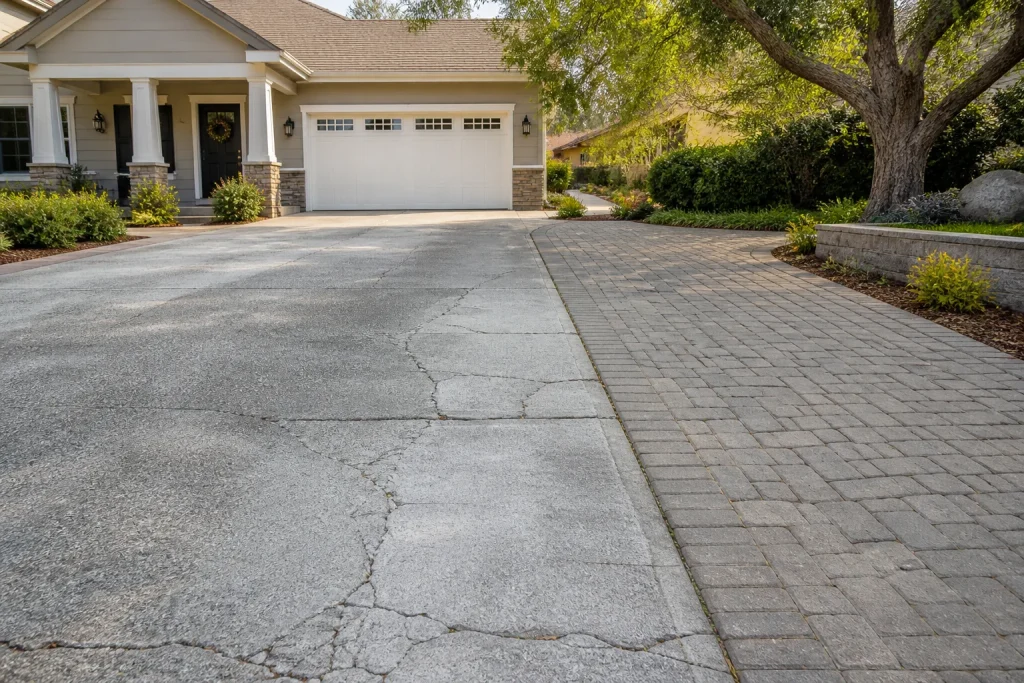
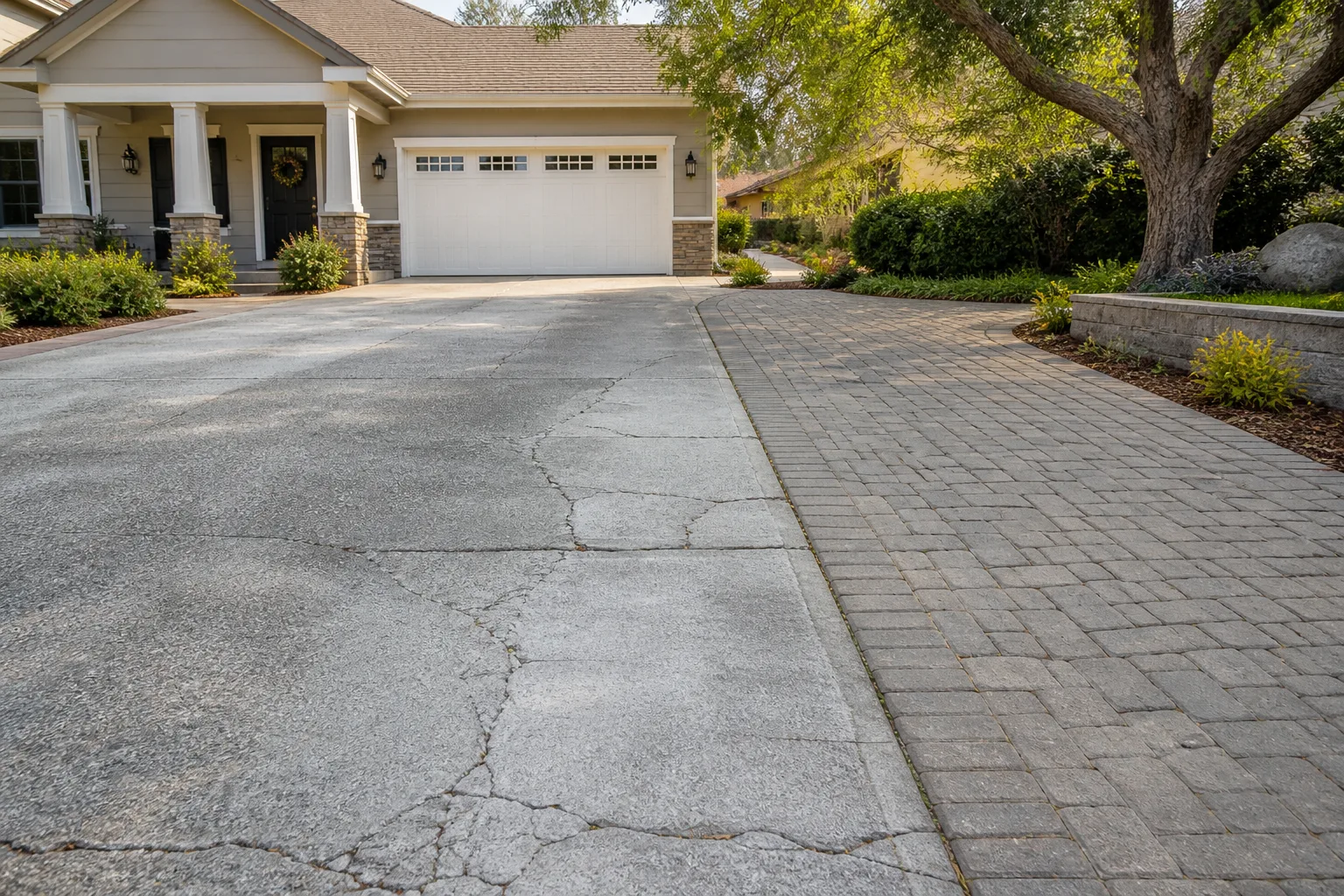
Driveway & Pavers: Repair or Replace? How Glendale Homeowners Decide
If three pavers shifted and your contractor immediately quoted a full driveway replacement, ask one question: “Did you dig down to look at the base?” If the answer is no, you may be buying a new driveway to solve a drainage problem that a repair and re-grading would fix for a third the price. The repair-or-replace decision in Glendale isn’t answered by looking at the surface. It’s answered by what’s happening six inches underneath.
Here’s the honest short answer before we get into the how: most driveways in Glendale can be repaired if the sub-base is still sound and the failure is localized. Replacement makes sense when the base has broken down across a wide area, or when the pavers themselves are past saving. Getting to that answer takes about an hour of actual digging. Below, we walk through how that assessment should work so you can hold any contractor to it. If you’d rather have someone walk your driveway and put their findings in writing, call (844) 560-4526.
Why the Surface Doesn’t Tell You What You Need to Know
A driveway shows its problems at the top but carries its causes at the bottom. Cracked pavers, sunken sections, and joints that won’t stop growing weeds can come from three very different sources: base failure, a drainage problem, or simple surface settlement. Each has a different cost and a different fix. The paver is the last thing to fail, not the first.
Glendale sits on some of the more active clay soils in the San Gabriel Valley. That clay expands when it holds water and shrinks when it dries, and it does this on a seasonal cycle. A driveway that looked flat in February can show a hump by August. So when you see a dip near the garage apron or a trip hazard at the sidewalk line, the surface paver is just reporting what the soil underneath has been doing all year.
This is why a fair assessment has to include a look below grade. If a contractor quotes you a number without lifting at least one paver and putting a shovel in the base, that number is a guess dressed up as a quote. In 29 years, we’ve learned that the dig is the difference between selling a repair and selling a replacement.
The Base Inspection Test: What a Contractor Should Do Before Quoting
A proper diagnostic follows a sequence. It’s not complicated, but it takes time and most of it happens before anyone talks about money. Here’s the order you should expect:
- Lift two or three pavers where the problem is worst. Not at the edge of the driveway. Right where the dip, hump, or wobble lives.
- Check the bedding sand. If it’s still evenly compacted, the failure is likely surface-level. If it’s washed away or filled with clay pushing up from below, you’ve got a base problem.
- Probe the base material. A screwdriver or rebar should meet firm resistance. If it pushes in easily or comes up wet, the sub-base has lost its compaction and won’t hold pavers no matter how many times you re-set the surface.
- Test drainage with a bucket of water. Pour a few gallons over the low spot and watch where it goes. If it pools and sits for fifteen minutes, you have a grading problem that a repair must solve or it will fail again.
- Check the slope toward the street and the garage. Some Glendale driveways were put in without enough pitch to the street or away from the foundation. Water then runs under the pavers instead of off them.
- Look at the pattern of failure. One localized area suggests a repair is fair. A crack or dip that spans the whole width of the drive and continues into the apron usually means the base has moved as a whole sheet.
Write down what you’re told at each step. If the contractor can’t tell you what the base looked like, that’s the signal. You don’t need to be a soil engineer; you need to know whether the person recommending replacement actually looked.
Repair vs. Replace: The Cost and Longevity Math
Here’s where Glendale homeowners get real clarity. Neither option is always cheaper. The right question is which option buys you the most years per dollar, given what the base is doing. These are typical ranges for a standard two-car driveway in the Glendale area, not quotes:
| Option | Typical Cost Range | Years Gained | Best When |
|---|---|---|---|
| Re-set and re-sand 10 – 30 pavers | $300 – $900 | 3 – 5 years | Localized settlement, sound base |
| Remove, re-grade, re-set one section with new base | $1,200 – $3,500 | 10 – 15 years | One area of base failure, rest is healthy |
| Full paver replacement, same base | $8,000 – $18,000 | 15 – 25 years | Pavers worn or broken, base still firm |
| Full replacement with base rebuild | $12,000 – $25,000+ | 20 – 30 years | Base failed across most of the drive |
Read that middle column closely. If a repair buys you three to five years and then the same section fails again, and you knew that going in, it can still be the right call for a homeowner planning to stay put at least a few more years or one thinking about selling. Three good years and a clear written explanation beats dropping fifteen grand on a driveway you don’t need yet. What isn’t fair is a repair sold as a permanent fix. That’s where the surprise eighteen months later comes from.
On the replace side, if the paver field is already uniform and the base is sound, a top-course replacement is worth considering. Some Glendale customers ask us about harder, higher-density pavers and even modular concrete systems; we’ve seen Boxabl and Mighty Buildings approach prefab differently, and on hardscapes we generally recommend proven pavers from Belgard and Techo-Bloc because you can look up the specs and match them years later if you need to repair a section.
Glendale’s Clay Soil and the Heave-and-Settle Cycle
There’s a reason this question comes up so often in Glendale specifically. That clay soil runs deep, and it swells and shrinks with the seasons. If your driveway sits on original clay without a properly compacted base layer, you’re going to see movement no matter what’s on top. Some neighborhoods with older builds and thin base courses are more prone to this than newer construction.
That matters for the repair-or-replace decision because it explains how a repair can be right and temporary at the same time. Where we see a localized heave near a tree root or a low spot next to a downspout, a targeted repair with fresh base and improved grading can hold for years. Where the whole drive sits on that clay and moves every wet winter, a repair is often buying time. That’s fine if you know it. It’s not fine if nobody told you.
Our crews have worked these soils for a long time – up to 28 years of experience on the team – and the pattern is consistent: the driveways that age well are the ones that had a base dug down, compacted, and graded to move water off and away. When we do a repair or a replacement in Glendale, that’s the part we won’t skip. It’s also why every scope and every allowance goes in writing before work starts. An allowance that isn’t on paper is a surprise waiting for a date.
What a Repair Scope Should Include in Writing
A repair without a written scope is a coin flip. Before anyone starts, the paperwork should spell out exactly what’s happening so you don’t get a call eighteen months later asking what went wrong. Here’s what should be in writing on any Glendale paver repair:
- Number of pavers lifted and re-set – a count, not a range.
- Whether the base is being re-built or just re-sanded, and if re-built, how deep the new base goes and what material.
- Grading and slope corrections – where runoff will go when the repair is done.
- Drainage changes – any downspout extensions, channel drains, or grading away from the foundation.
- Polymeric sand and joint stabilization – called out as a line item so you know it’s included.
- Any conditions where the scope could change, and the written change order that would follow if it does.
- Timeline and cleanup – when it starts, when pavers are removed from the property, and how trash and old sand are handled.
That written change order business matters. If the crew opens up the base and finds more than expected, you should get a paper in your hand before a single paver moves back down. No surprise invoices at the end. Every price change arrives in writing first, and if we got something wrong, the 90-Day Done Right Promise is on every contract. One call, Tom comes back, it gets fixed.
When to Call a Pro (and When Not To)
Some paver problems are safe for a careful homeowner to look at, and some shouldn’t be. Lifting one or two pavers to peek at the sand is fine. Re-setting a couple of pavers on a flat, stable section is fine for a reasonably handy person with a rubber mallet and a bag of bedding sand. But if you’re seeing a dip deeper than about half an inch, water pooling next to the foundation, or a section that’s heaved across several pavers, it’s time to have it looked at properly. That’s not a knock on DIY – it’s that the diagnosis is the whole job, and a wrong diagnosis means re-doing it in a year.
If you’d rather have an honest read on your Glendale driveway before spending a dime, call (844) 560-4526. We pull the pavers, check the base, look at the drainage, and put the findings in writing – repair or replace, whichever is right. Free second opinion on any written estimate you’ve already got, no trip charge inside the county.
Related services in Glendale: the same crew you’d talk to about pavers also handles Driveway & Pavers in Glendale, Fence Installation in Glendale, and Home Additions & ADU in Glendale when the driveway work ties into a bigger project. For anything else, start at Barrett & Sons Construction Glendale home.
The Bottom Line
Glendale pavers get replaced too often because the diagnosis never happened. The short version of what we’ve covered:
- Most driveways can be repaired when the base is still sound and the failure is localized.
- Replacement makes sense when the base is gone across a wide area, not when one corner has settled.
- Repairs can be right and temporary at the same time in Glendale’s clay soil – that’s expected, not a failure, as long as it’s on paper.
- A repair without a written scope is a surprise waiting on a calendar.
- No quote without a dig. If the base wasn’t checked, the number isn’t real.
If you’re in Glendale and want a real assessment rather than a guessed quote, Barrett & Sons Construction Glendale offers free estimates. Call (844) 560-4526, and we’ll dig down, look at the base, and put the findings in writing. Our 90-Day Done Right Promise backs every job, every price change arrives as a written change order, and every permit gets pulled and inspected. That’s how we’ve done it since 1998, and that’s how we’ll do it on your driveway.
Frequently Asked Questions
Most Glendale paver repair jobs fall between $300 and $900 for re-setting a localized area, and between $1,200 and $3,500 when a section needs its base re-built. The number depends on how many pavers are involved and how deep the base work goes. Call (844) 560-4526 for an exact quote – estimates are free.
Not without a written change order in your hand first. If the crew opens the base and finds more than expected, you get a paper before any work proceeds. Every scope, every allowance, and every price change is written down before it happens – that’s a habit we don’t break. Call (844) 560-4526 to schedule your free estimate.
Most localized repairs take a day or two. A section re-build with new base typically runs three to five days, depending on weather and how much of the driveway is involved. Full replacement runs one to two weeks. The written scope will tell you the timeline before work starts, and if anything changes, it comes to you in writing. Call (844) 560-4526 for a free estimate.
When a permit is required for the scope, yes – we pull it, and we get it inspected and signed. That’s on every eligible job, no matter the trade. If we’re just re-setting pavers on an existing driveway, a permit usually isn’t required, and we’ll tell you that in the written scope. Call (844) 560-4526 and we’ll walk through what your specific driveway needs.
Written by the team at Barrett & Sons Construction Glendale.
Need Construction Help?
Call Barrett & Sons Construction Glendale - licensed & insured, here with fast after-hours help in Glendale.
(844) 560-4526