
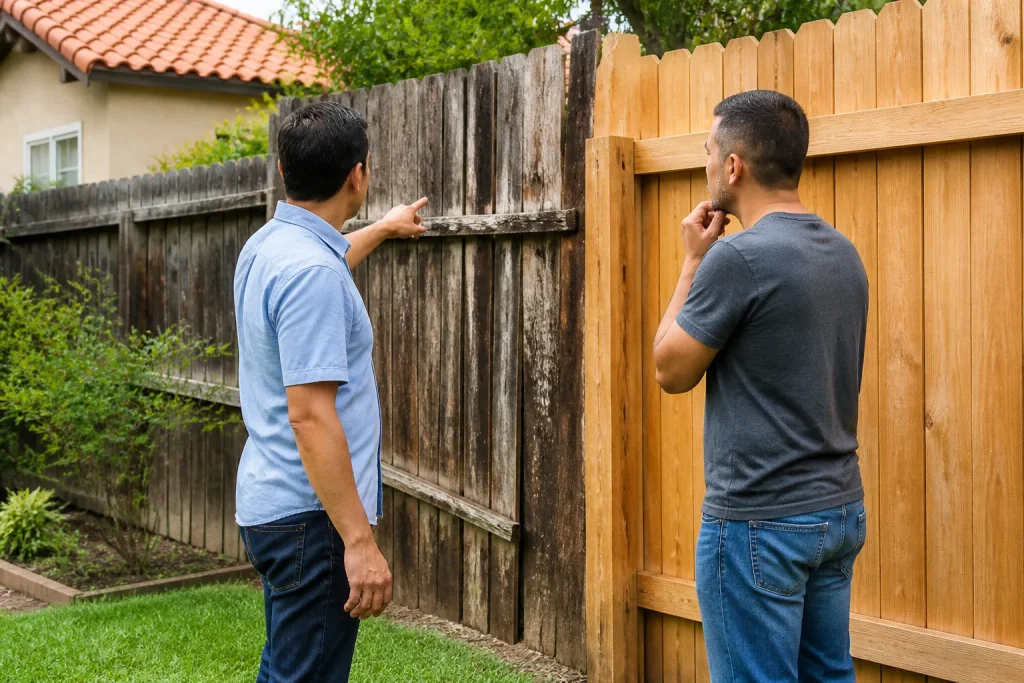
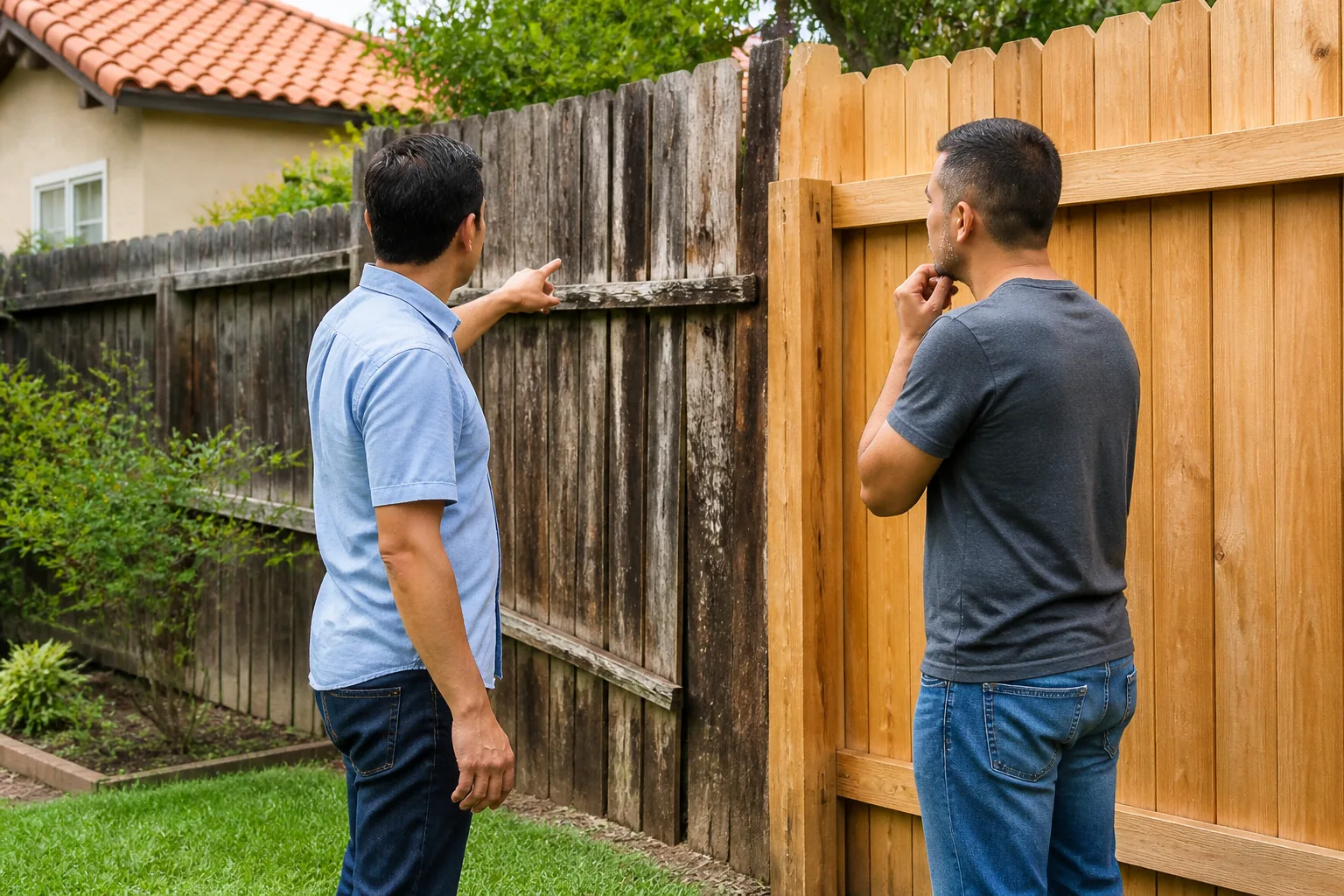
Fence Installation: Repair or Replace? How Glendale Homeowners Decide
A fence that looks like it’s falling apart might have another decade in it. A fence that looks fine can be six months from collapsing on a neighbor’s car. The difference is almost always underground, where nobody’s looking. Most Glendale homeowners make this call by walking the fence line and judging the boards they can see. That’s the wrong spot. The right spot is six inches below the soil, at the post base, and that’s where this decision actually gets made.
Here’s the short version: probe your post footings before you spend a dime on boards, paint or stain. If the bases are solid, a repair is usually money well spent. If they’re soft, no amount of new lumber will hold, and you’re looking at replacement. If you’d rather not get down in the dirt with a screwdriver, call (844) 560-4526 and we’ll take a look at no charge.
Key Takeaways
- Boards lie. Post bases tell the truth.
- Glendale’s clay-heavy soil shrinks and swells with the seasons, and that movement is brutal on buried posts.
- Cosmetic repair makes sense when the structure is sound. It’s a waste of money when it isn’t.
- Sometimes HOA or city setback rules force a replacement no matter how good the fence looks.
- A written scope before work starts is the difference between a repair and an open-ended bill.
Why the Post Base Decides Everything in Glendale
Glendale sits on clay. Not the crumbly, sandy stuff you can dig with your hands – real expansive clay that soaks up winter rain, swells, then shrinks hard in the dry months. That cycle pushes and pulls on every fence post in the ground, year after year. We’ve seen posts in Adams Hill that were set in concrete and still worked loose after a few wet seasons, and posts in Rancho Canyon that sat in shallow footings and somehow held for twenty years. The soil chemistry under your particular lot matters more than the fence’s age on a listing sheet.
Here’s the part most people get wrong: above-grade boards can look rough while the structure is perfectly solid, and a fence that photographs beautifully can be hanging on rotted stumps. We pulled one out of a backyard near Brand Park last spring where the cedar pickets were gray and splitting, and the homeowner had already budgeted for full replacement. Every post base was sound, set deep in concrete. New boards and a fresh stain would have bought another twelve to fifteen years. She saved a few thousand dollars by letting us probe first instead of assuming.
The test is simple, though you’ll get dirty doing it. Push a screwdriver or an awl into the post right at the soil line, on all four sides. If it slides in easily or the wood feels spongy, that post is failing. Do this at every post, not just the ones that look bad. If three or four posts are soft on a forty-foot run, replacement usually wins. If it’s one post holding a gate, that’s a repair.
How to Read the Post Base: A Step-by-Step Check
You don’t need special tools to get a real answer, just a few minutes and a willingness to get your hands dirty. Here’s the order we work in when we’re evaluating a Glendale fence for a homeowner:
- 1
Walk the whole line first, both sides. Note leaning posts, sagging gates, and boards that have pulled loose. Don’t judge yet – you’re just mapping the problems.
- 2
Probe every post at the soil line with an awl or screwdriver. Soft, spongy wood means rot is already inside. Hard resistance means the post is still carrying load.
- 3
Check the concrete footing where you can see it. A footing that’s cracked, heaved up, or tilted out of plumb has failed, even if the post looks fine above ground. That tilt is what makes gates drag.
- 4
Grab each post and push. A post that moves more than a half inch at the top has lost its footing and needs attention.
- 5
Look at the bottom rail and the lowest board. Those sit closest to splashing rain and are usually the first to go. If the bottom rail is soft but the posts are sound, that’s a straightforward repair.
Do this in the dry season, not after a rain, when soft wood hides its weakness. If you probe in January, everything feels loose and you’ll talk yourself into a replacement you don’t need. If you’re not comfortable crawling the line yourself, a free estimate from us will give you the same answer with a written scope attached.
When Repair Is the Right Call, and When It’s Money Down the Drain
Repair genuinely makes sense more often than you’d think. Board replacement, re-staining, a gate rehang, replacing a single failing post – these are real fixes that extend a fence’s life by years when the structure underneath is sound. On a cedar or pressure-treated fence with solid posts, replacing the bottom fifteen or twenty boards along a forty-foot run is a routine job, and it’s a fraction of what a full replacement costs. Same with re-staining: a quality penetrating stain on a structurally sound fence will buy you another season or two of protection, and it’s a job a careful homeowner can do themselves.
Repair becomes money down the drain when you’re patching a fence whose posts are already gone. New boards nailed to a rotted post will look fine for one season, then sag as the post continues to fail. We’ve seen this exact pattern on older fences in Glendale’s Chevy Chase area: a homeowner pays for a partial board replacement, the fence looks great in June, and by the following spring the whole thing is leaning because the four posts holding it were already dead. You paid twice.
The honest guideline: if more than a quarter of your posts fail the probe test, replace. If two or fewer fail on a normal run, repair. If the fence is a shared property line and your neighbor is willing to split the cost of replacement, that changes the math too.
When Glendale Rules Force a Replacement
Sometimes the fence’s condition doesn’t matter at all. If you’re replacing or repairing a fence in Glendale and you happen to be rebuilding a section, the city’s setback and height rules apply to the new work, not the old. A privacy fence in a front yard faces stricter height limits than one in a back yard, and corner lots have sight-line requirements at the intersection. If your existing fence predates a rule change, it might be grandfathered – but the moment you replace it, the new fence has to meet current standards. Repair a board, keep the old envelope. Rebuild the whole thing, and you may be knocked down to a lower height.
HOAs add a layer. Many Glendale-area HOAs require style, material, and height approval before any fence work, repair or replace. An HOA can also require matching fencing along a shared perimeter, which forces replacement of a section you’d otherwise have left alone. Before you commit to a repair, pull your HOA’s architectural guidelines and check the city’s fence height rules for your zoning. If you’re not sure where to look, the permit counter will tell you – and if the job requires a permit, we pull it and get the inspection signed.
The Real Cost Comparison: Repair vs. Replace in Glendale
Here are the ranges we see on typical Glendale jobs. These are honest numbers, not teaser quotes, and they depend on fence length, material, and access to the property line. Every job gets a written line-item quote with allowances spelled out – an allowance that isn’t on paper is a surprise waiting for a date.
| Job | Typical Glendale Range | What It Covers |
|---|---|---|
| Board replacement (40-ft run) | $900 – $1,800 | Remove and replace pickets and bottom rail |
| Single post replacement | $350 – $700 | Dig out old post, set new footing, reset |
| Gate rehang / hinge repair | $200 – $450 | New hardware, adjust alignment |
| Re-stain / seal (100 ft) | $600 – $1,400 | Clean, prep, two coats penetrating stain |
| Full replacement, wood (100 ft) | $3,200 – $6,500 | New posts, rails, pickets, footings |
| Full replacement, vinyl (100 ft) | $4,500 – $8,000 | Premium vinyl system, capped posts |
Notice the gap: a repair typically runs between a fifth and a third of a full replacement. That’s the reason the post-base test is worth doing carefully. If the structure is sound, a $1,400 repair beats a $5,000 replacement every time. If the structure isn’t sound, that same $1,400 is a down payment on a problem you haven’t solved.
Why getting it in writing matters
Here’s the trap. A “quick repair” quote starts at $800 for board replacement, then the crew gets in and finds two posts need replacing, then the bottom rail needs new hardware, then the gate won’t close without a realignment. That’s how an $800 repair becomes a $3,200 bill you never agreed to. Every scope, every allowance, and every price change should arrive as a written change order before the work happens. No surprise invoices at the end. If a contractor won’t put the scope in writing, walk away – the written scope is your protection, not theirs.
When to Call a Pro
If a post needs replacing, if the footing has failed, or if the run is long enough that the job runs into a weekend you’d rather not spend, call us. Post replacement involves digging out old concrete and setting a new footing to depth – not dangerous, but not worth doing halfway. If your fence is on a shared property line, getting the neighbor’s agreement in writing before work starts will save you more headaches than the job itself. And if the job touches a permit or HOA approval, we handle both.
If you’re weighing fence work against other exterior projects – a new paver driveway, a home addition, or a full front-yard redo – it all works better when it’s planned as one scope. You can see what we offer for Fence Installation in Glendale, Driveway & Pavers in Glendale, and Home Additions & ADU in Glendale if you want to think about the whole picture. And if you’re just getting a feel for how we work, the Barrett & Sons Construction Glendale home page is a good place to start.
The Bottom Line
The repair-or-replace decision on a Glendale fence isn’t really about age or appearance – it’s about what’s happening at the post bases. Probe every post at the soil line, check the footings for tilt and cracking, and let the underground evidence make the call for you. If the structure is sound, repair is usually the right move and saves you thousands. If the posts are gone, replacement is the only answer that holds, and patching boards to failing posts just moves the bill to next spring.
What we’ve learned from years of doing this is that homeowners who get a written scope up front almost never get surprised. The ones who chase a verbal “quick repair” quote often do. Get the scope in writing, get the allowances in writing, and get any price change in writing before work starts.
If you’re in Glendale and need help deciding whether to repair or replace your fence, Barrett & Sons Construction Glendale offers free estimates – call (844) 560-4526. We’ll probe the posts, give you an honest read, and put it all in writing before anyone touches a board.
Frequently Asked Questions
Probe every post at the soil line with a screwdriver. If the wood is soft or spongy, that post is failing. If more than a quarter of your posts fail the test, replace the fence; if only one or two fail, repair is usually the right call. Check the concrete footings for cracking or tilt, and inspect the bottom rail for rot. If the structure is sound above ground, a repair will buy you years. Call (844) 560-4526 for a free assessment if you’re unsure.
Repair is almost always cheaper in the short term – a board replacement typically runs $900 to $1,800 against $3,200 to $6,500 for a full replacement on a 100-foot run. But if the posts are failing, repair is false economy: new boards on rotted posts will sag within a season, and you’ll pay twice. The post-base test decides which case you’re in. Call (844) 560-4526 for an exact quote with line items.
Fence repair usually doesn’t need a permit, but replacement often does – and it depends on height, location, and zoning. If you rebuild a fence, it has to meet current setback and height rules even if the old one was grandfathered. An HOA may also require style and height approval before any work. Before you commit to a repair or replacement, check with the city permit counter and your HOA. If the job needs a permit, we pull it and get the inspection signed.
A typical 100-foot wood fence replacement takes two to three working days once materials arrive and permits clear. Vinyl usually runs two to four days. Repairs are often done in a single day unless a post footing needs to be dug out and re-poured. The timeline depends on access to the property line, the number of posts being replaced, and whether a permit inspection is involved. Call (844) 560-4526 and we’ll give you a real timeline with the written quote.
Written by the team at Barrett & Sons Construction Glendale.
Need Construction Help?
Call Barrett & Sons Construction Glendale - licensed & insured, here with fast after-hours help in Glendale.
(844) 560-4526